
Improving Cement Quality Control with Automated Split Loss on Ignition Analysis
Published by Kristian Ilasko,
Digital Content Coordinator
World Cement,
Improving cement quality control with automated split loss on ignition analysis
Loss on ignition (LOI) remains a cornerstone of cement quality control, providing essential insight into raw materials, clinker, and finished cement performance. By quantifying mass losses during controlled heating, LOI testing helps laboratories understand moisture content, carbonate levels, and other volatile components present in the material that can influence cement properties, storage stability, long-term durability, and more.
While conventional LOI testing delivers a total mass-loss value, cement producers often require more detailed information to effectively diagnose process issues. Split loss on ignition analysis addresses this need by separating mass loss into defined temperature intervals, allowing laboratories to distinguish between physically bound moisture and chemically bound carbonates – two parameters of particular relevance in cement manufacturing.
Why split LOI matters in cement production
Traditional LOI methods typically involve heating a cement sample to high temperatures – often approaching 1000°C – and reporting the total loss in mass. Although this result is valuable for compliance and reporting, it does not differentiate between the distinct mechanisms contributing to that loss.
Split LOI analysis improves resolution by evaluating mass changes at two key temperature points commonly used in cement applications:
- Around 550°C, where free moisture and low-temperature volatiles are released.
- Around 950°C, where carbonate decomposition occurs and CO2 is liberated.
By measuring the mass difference between these temperature steps, laboratories can better estimate moisture content and carbonate-related CO2 loss independently. As a result, split LOI has become an established component of cement quality control programmes. This supports both routine monitoring and root-cause investigations when chemical analyses fall outside expected limits.
Advancing split LOI through automation
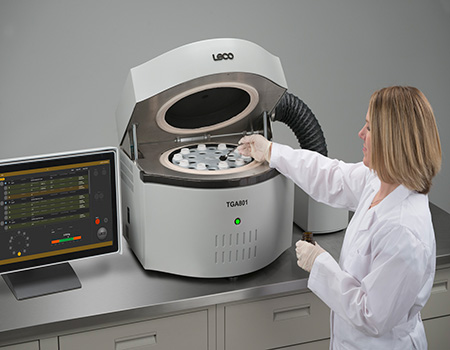
Historically, split LOI testing has required multiple heating steps or manual intervention between temperature stages, increasing analysis time and the possibility of operator-induced variability. Recent developments in thermogravimetric analysis (TGA) have simplified this workflow through automation.
Modern macro TGA systems designed for cement applications can now perform split LOI determinations in a single, continuous run. Once samples are loaded and the method is initiated, the system heats from ambient temperature to the first target temperature, records mass loss, and then proceeds directly to the higher temperature without interruption. Both intermediate and total LOI values are calculated automatically, eliminating the need for rehandling or method changes mid-analysis.
This uninterrupted workflow reduces sample exposure, minimises analytical variability, and improves overall laboratory efficiency – particularly for facilities processing large numbers of samples each day.
Throughput and productivity in the cement laboratory
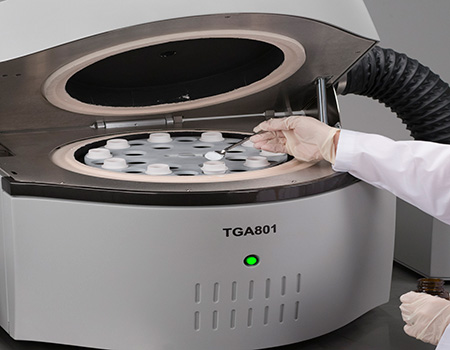
High-throughput capability is increasingly important as cement laboratories balance production demands with strict quality requirements. Automated TGA instruments designed for macro sample sizes allow multiple cement samples to be analysed simultaneously, supporting efficient batch processing without compromising data quality.
By removing manual steps between temperature stages, laboratories can reduce hands-on time and focus more on data interpretation and process control rather than instrument operation. This streamlined approach is especially advantageous for plants operating under tight turnaround times or supporting multiple production lines.
Consistency and compliance confidence
Repeatability is critical in LOI testing, particularly when results support broader chemical analyses performed under standards such as ASTM C114. Automated split LOI methods rely on predefined temperature ramps, hold times, and controlled atmospheres, ensuring that each sample is subjected to identical conditions.
This level of standardisation helps reduce operator-to-operator variability and supports consistent results across shifts, instruments, and facilities. Reliable split LOI data strengthens confidence in day-to-day quality monitoring, raw material verification, and corrective actions when deviations are detected.
Supporting smarter cement quality decisions
For cement producers seeking deeper insight, automated split loss on ignition analysis offers a practical, data-driven improvement over traditional LOI workflows. By delivering both intermediate and total LOI values in a single analysis, modern thermogravimetric systems help laboratories work more efficiently while maintaining the accuracy and consistency essential for cement quality control.
As the cement industry continues to prioritise performance, durability, and process optimisation, precise and repeatable analytical tools like automated split LOI play an important role in supporting informed decision-making at every stage of production.
To find out more information about LECO Corporation click here.
Read the article online at: https://www.worldcement.com/special-reports/30042026/improving-cement-quality-control-with-automated-split-loss-on-ignition-analysis/
You might also like
The World Cement Podcast
A podcast series for professionals in the cement industry featuring short, insightful interviews. Subscribe on your favourite podcast app to start listening today.


