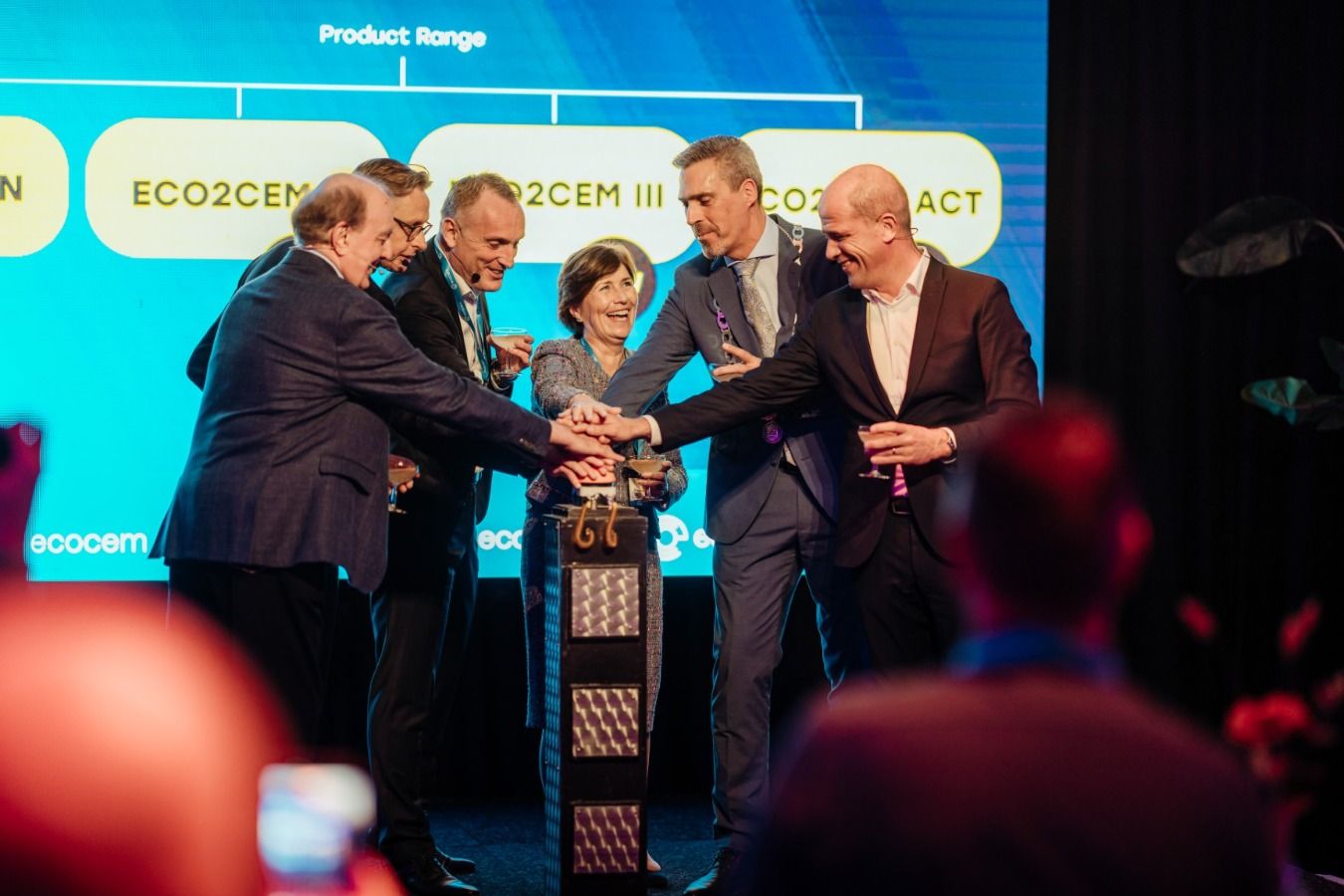
Marking 25 years of pioneering low-carbon cement solutions in the Benelux region, Ecocem is entering a new phase of growth. Building on its established GGBS business, the company is expanding its range of low-carbon cement solutions to meet evolving customer needs and help accelerate the decarbonisation of concrete.
Ecocem is investing €12 million in its Moerdijk operations, adding new silo capacity, laboratory facilities, and advanced blending technology to enable industrial-scale production of its latest innovations.
The new products and investment in Moerdijk were announced at an event held at Ecocem’s Moerdijk facility. Approximately 150 guests attended, including Dr Ann Derwin, Ireland’s Ambassador to the Netherlands, and Aart-Jan Moerkerke, Mayor of Moerdijk. Speakers included Donal O’Riain, Founder and CEO of Ecocem; Han ten Broeke, Head of Cabinet to European Commissioner Wopke Hoekstra; and Diederik Samsom, former Head of Cabinet to Frans Timmermans.
Faster strength development with lower CO₂ emissions
The precast concrete industry faces the challenge of reducing CO₂ emissions while maintaining efficient production processes. Concrete products need to be demoulded quickly so production moulds can be reused, leaving many manufacturers dependent on cement with a high clinker content.
GGBS can replace a substantial proportion of clinker, significantly reducing CO₂ emissions. However, its relatively slower strength development can limit its use in precast production. ECO2CEM R offers a solution to this challenge.
Developed at the company's state-of-the-art Innovation Centre near Paris, the product features an optimised composition with increased early reactivity. This enables concrete mixes to achieve higher early strength, allowing precast producers to use a greater proportion of GGBS and further reduce clinker content and CO₂ emissions without compromising production efficiency.
"The challenge in decarbonising precast concrete is to reduce CO₂ emissions without losing sight of production efficiency," says Paul Roos, Managing Director of Ecocem Benelux & Ireland. "With ECO2CEM R, we make it possible to replace more Portland cement while maintaining the required early strength. This makes further CO₂ reduction not only technically feasible, but also economically attractive."
A sustainable blend developed specifically for the precast industry
Ecocem will introduce ECO2CEM III in 2027, a CEM III blend developed specifically for the precast industry. While some concrete producers have the equipment and silo capacity to blend different materials themselves, others need a ready-to-use cement. ECO2CEM III addresses this need with a pre-blended solution, making lower-carbon cement easier to adopt without adding complexity to existing production processes.
Diederik Samsom, former Head of Cabinet to Frans Timmermans, spoke at the event about the need for continued investment in innovations that support a sustainable future, emphasising the role that companies such as Ecocem can play in accelerating the transition.
"The clean technologies that have the most impact are often the simplest ones. Ecocem is living proof of that. As a physicist, I am deeply inspired by the innovation that Ecocem has been making to a centuries-old product. Europe needs more champions like Ecocem."
The next generation of low-carbon cement
Ecocem is bringing its breakthrough ACT technology to the Benelux market. Developed over more than ten years of research, ACT offers a scalable solution to rapidly and cost-effectively decarbonise the cement and concrete industry.
The low-clinker cement technology is designed to use a broad range of locally available SCMs and engineered fillers to deliver the high performance of conventional cement with up to 70% less CO₂.
Unlike solutions that depend heavily on the availability of GGBS, ACT is designed to use a broader range of locally available raw materials. This is an important step towards making low-carbon cement production scalable beyond existing slag supply.
Ecocem expects to begin supplying ACT to customers from its new Dunkirk facility in the first quarter of 2027.
Paul Roos added, "With ECO2CEM R, we are improving the performance of our existing GGBS solutions. With ACT, we are taking a fundamentally new step towards scalable low-carbon cement. Both developments share the same objective: helping our customers reduce CO₂ emissions with solutions that meet the practical requirements of our industry in terms of performance, availability, and cost."
Donal O’Riain, Founder and CEO of Ecocem, noted that the Dutch construction sector, supported by the Dutch Concrete Agreement (Betonakkoord), provides an ideal market for introducing innovations and serves as an example for other countries.
"The Netherlands is proving that clear targets, a level playing field, and the freedom to innovate can accelerate low-carbon construction at scale. I hope the progress being made here will inspire a new generation of climate leadership across Europe."
€12 million investment in Moerdijk, Netherlands
The €12 million investment includes additional silo capacity, a laboratory, and an advanced blending facility capable of combining different raw materials and GGBS fractions. Beyond increasing capacity, the investment will give Ecocem greater flexibility to manufacture a wider range of low-carbon cement solutions tailored to different customer applications and performance requirements.
Construction is underway, with the new blending installation expected to be completed by mid-2027 and deliveries of ECO2CEM R and ECO2CEM III scheduled to begin in the second half of 2027.
Paul Roos concluded, “For 25 years, we have helped our customers reduce the carbon footprint of concrete using GGBS. With these new products and our investment in Moerdijk, we are taking the next step. We are building on our established GGBS business to offer a broader range of low-carbon cement solutions, giving customers more choice, improved performance and new opportunities to reduce CO₂ emissions.”
During the launch event, Han ten Broeke, Head of Cabinet to European Commissioner Wopke Hoekstra, stressed that effective policy is essential for driving progress. He highlighted the European Commission's work on measures aimed at creating the conditions for companies such as Ecocem to thrive.
“Ecocem is a true example of sustainable industrial leadership. It demonstrates how Europe’s climate and industrial policies can work together.”