
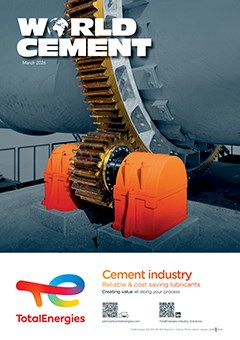
March 2026
The March issue of World Cement takes a deep dive into the topic of decarbonisation. The issue kicks off with an update from the VDZ on the rise of clinker-efficient cements, updated standards, and new carbon labelling; this is followed by a report from Mannok on the company’s efforts to decarbonise and promote resilience in the Irish construction sector. The issue then moves on to cover a range of topics, including: Lubrication, Alternative Fuels, Clinker Cooling, Blended Cements & SCMs, Waste Heat Recovery, Carbon Capture, and AI & Process Optimisation.
This month's front cover is brought to you by TotalEnergies Lubricants.
Register for free »
Get started now for absolutely FREE, no credit card required.
Contents
Comment
News
LEAD REPORT: DECARBONISATION UPDATES
Germany’s Clinker Cut Revolution
Christoph Müller, VDZ, examines how clinker-efficient cements, updated standards, and new carbon labelling are accelerating the shift towards climate-friendly cement in Germany.
Insights From The Island Of Ireland
Paul Monaghan, Mannok, examines how long-term sustainability, local resources, and renewable energy are driving decarbonisation and resilience in Ireland’s construction sector.
COVER STORY: LUBRICATION
Beyond The Gear
Nicola De Laurentis, TotalEnergies, outlines how strategic lubrication extends the life of ball mills.
ALTERNATIVE FUELS
Analyser Advancements
Adrián Erazo, UNACEM Ecuador, details how a strategic re-engineering of gas analyser systems overcame corrosion challenges and boosted reliability when using alternative fuels.
The Hydrogen Lever
Argos explains how hydrogen can enhance kiln performance while supporting decarbonisation strategies and competitiveness in cement manufacturing.
CLINKER COOLING
Cooling With Control
Claudius Peters explores how operational flexibility, advanced cooling concepts, and data-driven control are shaping the next generation of clinker cooler performance.
BLENDED CEMENTS & SCMs
SCMs: Making A Material Difference
Eoin Condren, Ecocem, explains why scaling proven low-carbon cement technologies through the efficient use of supplementary cementitious materials is the industry’s most urgent decarbonisation priority.
Volcanic Value Unleashed
Yuta Fukushima, Takayasu Itoh, and Masashi Osaki, Mitsubishi UBE Cement Corporation, investigate the potential of weathered volcanic ejecta as alternative supplementary cementitious materials to support low-carbon cement production in Japan.
WASTE HEAT RECOVERY
The Case For ORC
Xiao Meng, Sinoma-EC, explores the advantages of ORC technology for efficient and resilient waste heat power generation in cement production.
The Waste Heat Opportunity
Daniel Loerwald, Oliver Weishaupt, Kenneth Hoffmann, and Robert Unsworth, GEA, outline an approach to optimise the heat balance utilising high and low-temperature waste heat sources.
Putting Heat To Work
Dr. Andreas Sichert, Orcan Energy, presents a range of case studies showcasing the role of waste heat recovery in decarbonising cement production.
Harnessing Hidden Heat
Sara Milanesi, Exergy, explores the deployment of ORC waste heat recovery as a mature and scalable pathway to lower cement sector emissions.
AI & PROCESS OPTIMISATION
The Power Of Anticipation
Bodil Recke, ABB Process Industries, examines how predictive maintenance, advanced process control, and AI are helping operators anticipate change and maintain process stability.
Masterful Mathematical Modelling
Michael Stanzel and Oliver Sohn, Chryso Saint-Gobain, demonstrate how advanced mathematical modelling is unlocking new levels of efficiency, quality, and optimisation in cement manufacturing.
CARBON CAPTURE
From Emissions To Solutions
Valérie Léveillé, Shell Catalysts & Technologies, and Rebecca Eason, Technip Energies, explain how their alliance leverages proven carbon capture technology and integrated project solutions to enable deep decarbonisation.
Register for free »
Get started now for absolutely FREE, no credit card required.